
New Orleans Humidity and Mold: How to Keep Your Home Below 60%
Mold needs three things: a food source, the right temperature and moisture. Every house in New Orleans has the first two all year. Moisture is the one you can control, and in this climate that mostly means controlling indoor humidity. This guide uses NOAA's climate normals and EPA's humidity targets to explain why New Orleans homes grow mold so easily, and what your air conditioner, a dehumidifier and a few habits can do about it.
How humid is New Orleans, really?
NOAA's 1991–2020 climate normals for New Orleans International Airport in Kenner show about 63 inches of rain a year. June is the wettest month, and no month averages less than about 3.7 inches. Rain is only part of the story, though. The number that matters most for mold is the dew point: the temperature at which water vapor in the air turns into liquid on a surface.
| Month | Rain (in) | Mean high (°F) | Mean dew point (°F) |
|---|---|---|---|
| January | 5.18 | 62.5 | 44.8 |
| April | 5.22 | 78.5 | 59.2 |
| May | 5.64 | 85.3 | 66.1 |
| June | 7.62 | 90.0 | 71.9 |
| July | 6.79 | 91.4 | 73.9 |
| August | 6.91 | 91.3 | 73.9 |
| September | 5.11 | 88.1 | 70.2 |
| October | 3.70 | 80.6 | 61.4 |
From June through August the average dew point at the airport sits at about 72–74°F. That means any surface in or under your house that is cooler than the low 70s can collect condensation from outdoor air. Common examples: AC supply ducts and registers, the underside of a cooled floor over a crawl space, cold-water pipes, and the back of a closet on an outside wall.
What indoor humidity does EPA recommend?
EPA's guide to mold and moisture says: "If possible, keep indoor humidity below 60 percent (ideally between 30 and 50 percent) relative humidity." In a New Orleans summer, outdoor air holds far more water than that. A house stays in EPA's range only while something is removing moisture from the air, and in most homes that something is the air conditioner.
A cheap digital hygrometer (a small humidity gauge) tells you where you stand. Put one in the main living area and one in the room that smells mustiest. Check them in the morning and again in the afternoon for a week. Readings that stay above 60% are a sign to act, even if you do not see mold yet.
Quick targets. Keep indoor relative humidity below 60%, ideally 30–50% (EPA). Fix leaks and dry anything that gets wet within 24 to 48 hours (EPA). Treat a musty smell that keeps coming back as a moisture problem to find, not an odor to cover.
How your air conditioner controls humidity
An air conditioner cools air by passing it over a cold coil. Water in the air condenses on that coil, drips into a pan and leaves through the condensate drain. That is why the drain line drips all summer. A few things decide how well this works:
- Run time. The coil removes moisture only while it is cold and air is moving over it. A system that runs in long cycles usually pulls out more water than one that turns on and off every few minutes. Short cycling can be a sign the system is larger than the house needs; an HVAC contractor can check.
- Fan setting. Leaving the thermostat fan on "On" instead of "Auto" can blow air across a wet coil after the compressor stops, which can return some moisture to the house. Many homeowners here keep it on "Auto" for that reason. Ask your HVAC contractor what fits your system.
- Thermostat set-back. Shutting the AC off for a long trip in August lets humidity climb inside. Setting it a few degrees higher, rather than off, keeps it removing moisture.
- Drain and filter. A clogged condensate line can overflow into a ceiling or closet, and a dirty filter can let dust collect on a damp coil. Change filters on schedule and have the drain cleared during routine service.
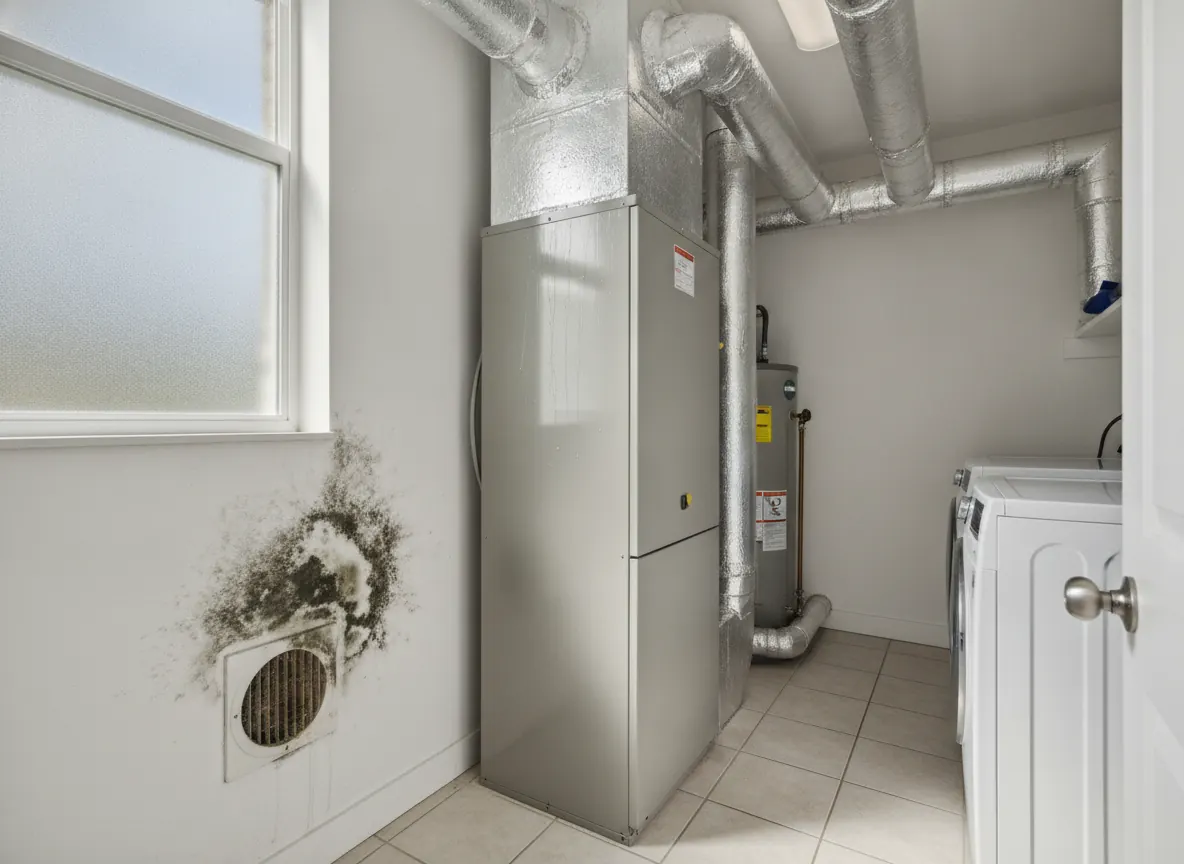
If you see mold on the air handler, on supply registers or inside ducts, don't keep running the system over it while you wait. Our HVAC and duct mold page explains what an HVAC-related mold job usually involves.
When does a dehumidifier help?
A dehumidifier is useful where the AC cannot reach or cannot keep up:
- Rooms that stay closed or have weak airflow, such as a back bedroom, a storage room or a closet on an exterior wall.
- Spring and fall days when it is too mild for the AC to run much, but the air is still damp.
- Drying out after a leak or minor water event, alongside fans.
- A conditioned or encapsulated crawl space, where a contractor may recommend one as part of the design.
Pick a unit sized for the space on the manufacturer's label, set it to about 50%, and empty the bucket or connect a drain hose. A dehumidifier in a room with an open window just dries the neighborhood. Whole-house dehumidifiers that tie into the duct system are another option; an HVAC contractor can tell you whether your house is a good fit.
Everyday habits that cut indoor moisture
- Run the bathroom exhaust fan during showers and for about 20 minutes after. Make sure it vents outdoors, not into the attic. See our bathroom mold page for more.
- Use the range hood when you boil seafood or cook a big pot of anything.
- Check that the clothes dryer vents outside and the vent flap opens freely.
- Keep furniture a few inches off exterior walls so air can move behind it.
- Look under sinks and around the water heater, dishwasher and ice maker line once a month.
- Clean gutters and make sure downspouts carry water away from the house, especially on raised homes where water can pool under the floor.
Humidity after a storm or power outage
The hardest time to control humidity is right after a hurricane, when the house may be wet and the power is out. After Hurricane Ida in August 2021, the National Weather Service reported that all power was lost in Jefferson Parish, and outages lasted days or longer across the metro. Without AC, indoor air quickly moves toward outdoor humidity.
When power returns, start the AC as soon as it is safe, run fans and dehumidifiers, and remove wet materials you cannot dry within EPA's 24–48 hour window. If ducts or the air handler took on water or show mold, have them checked before you run the system for long. Our flood and water damage mold page covers what to do after water gets inside.
When prevention isn't enough
Good humidity control stops new growth. It does not remove mold that has already taken hold in drywall, insulation or wood. EPA says an area under about 10 square feet can usually be cleaned by the homeowner. Larger areas, mold that comes back after cleaning, or mold inside walls, ducts or the attic usually call for a professional.
Published national ranges put a typical remediation job at about $1,200–$3,750 (This Old House, Mar 2026) or $1,500–$9,000 (Fixr, Aug 2025). The mold remediation cost page has the full table and a calculator. For attic growth from warm, humid air and roof leaks, see our attic mold page.
Louisiana license check. Louisiana requires a Mold Remediation license from the Louisiana State Licensing Board for Contractors (LSLBC) for mold remediation projects of about $7,500 and up (La. R.S. 37:2150.1). Before you sign, look up the company's license on the LSLBC website. In Louisiana, a mold remediation contractor may not also do the mold assessment on the same property, or own the company that does (R.S. 37:2158).
NOLA Mold Remediation is a free quote service, not a mold company. Describe your situation any time, and independent local companies reply on their own schedules. Some companies pay to receive requests. Request a free quote or call (504) 370-1142.
Frequently asked questions
What humidity level causes mold in a house?
EPA recommends keeping indoor relative humidity below 60 percent, ideally between 30 and 50 percent. Readings that stay above 60 percent for long stretches make mold growth more likely, especially on cool surfaces like ducts, closets on exterior walls and the floor over a crawl space.
Does running the AC prevent mold in New Orleans?
It helps a lot. An air conditioner removes moisture as air passes over its cold coil, which is how most New Orleans homes stay near EPA's humidity range in summer. It works best with long run cycles, a clean filter and a clear condensate drain. It does not fix leaks or remove mold that is already growing.
Should I run a dehumidifier all the time?
Not necessarily. Use one where you measure humidity above 60 percent: closed rooms, closets, mild spring and fall days, or while drying out after a leak. Set it to about 50 percent, keep doors and windows closed, and empty or drain it so it keeps working.
Why does my house smell musty even though I don't see mold?
A musty smell often means mold or moisture somewhere you can't see, such as behind a wall, under a sink, in ducts or in the crawl space. Check humidity with a hygrometer and look for leaks. If the smell keeps returning, a mold inspection can help find hidden growth.